Consent Logs are Cookie Compliance’s audit trail of consent events. They appear in the application, export to CSV, and follow your plan’s retention window. Additionally, logs cover two areas—Cookie Consent (banner choices) and Privacy Consent (policy/notice acknowledgments)—so you keep a clear record for audits and internal reporting.
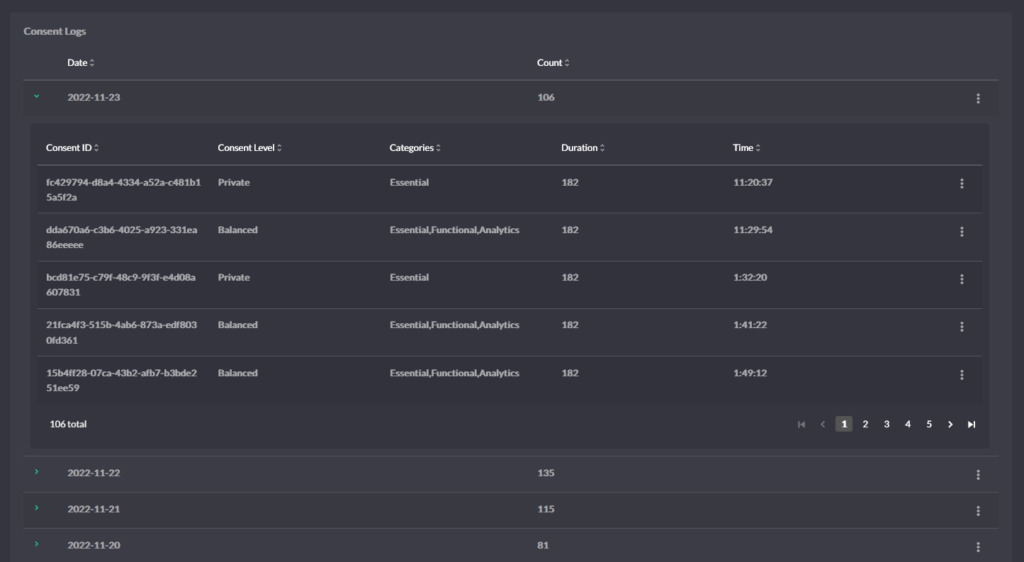
What’s stored per entry
- Access Level at the time (Private, Balanced, or Personalized).
- The Purpose Categories enabled by that Access Level (e.g., Basic Operations; Site Optimization; Content/Ad Personalization).
- The timestamp of the choice.
- Configuration reference (so you can tie the decision back to the banner settings in effect).
- Consent record ID (for correlation across exports/reports).
What it proves
- The visitor saw the banner, made a specific choice, and, when applicable, changed or revoked it later.
- Autoblocking and integrations acted on the permitted purposes at that moment.
How entries are created and updated
- First decision — the visitor’s initial action (accept/reject) creates the first log entry.
- Change — a later change (e.g., Balanced → Personalized) creates a new entry; the previous one remains intact.
- Revoke — withdrawing consent creates another entry, which preserves history.
Entries are kept unless they are deleted. In the dashboard you can delete a Privacy Consent entry only on the day it was recorded; Cookie Consent entries cannot be deleted there.
Privacy Consent
This section records non-cookie consent acknowledgments captured via privacy notices or forms you configure. For example, it tracks acceptance of policies, declarations, or similar site-level consents distinct from cookie choices.
What’s stored per entry
- Consent item (the name/identifier of the privacy notice/policy/declaration shown).
- Decision (accepted / declined / withdrawn) and timestamp.
- Configuration reference (the version of the text/notice presented).
- Consent record ID for correlation.
- Optional contact fields if you explicitly collect them in your notice/form (e.g., an email); you may anonymize these fields.
What it proves
- A specific privacy notice or declaration was presented and accepted/declined at a given time, separate from cookie consent.
Working with logs in the application
In the application, the Consent Logs view shows a chronological list of recorded events. Use the anonymization control to mask optional identifiers (e.g., IP or email) right in the UI—this is often required before sharing screenshots or exports. Open any row to see its details: for Cookie Consent, you’ll see the Access Level and the Purpose Categories in effect at that moment; for Privacy Consent, you’ll see the specific policy/notice item and decision. Each entry also includes a configuration reference and a consent record ID so you can correlate what you see on screen with your CSV export or Proof of Consent report. Cookie Consent exports follow your IP anonymization setting. Privacy Consent date-range exports do not mask IP or email, so check them before sharing.
Data anonymization
Data anonymization is designed to reduce exposure to personal identifiers in Consent Logs—especially when you’re viewing entries in shared spaces, exporting CSVs for audits, or sending samples to vendors. Use it to uphold data-minimization principles and avoid circulating raw IPs or emails when they’re not strictly necessary for the task at hand. You might choose not to anonymize temporarily if you’re doing a narrow, internal investigation that genuinely requires the original identifiers (e.g., correlating a specific complaint or debugging a single session); in those cases, switch it off only for as long as needed, then restore anonymization before sharing or exporting.
What you can anonymize
- IP address — hides part of the IP when logs are shown (the full IP is still stored).
- Email (only if you collect one in a Privacy Consent form/notice) — hides part of the address when logs are shown (the full address is still stored).
What anonymization does (and doesn’t)
- Does: partly mask IPs and emails in the logs view, in Cookie Consent exports and in single Privacy Consent exports (not in Privacy Consent date-range exports); keep all consent facts intact (event time, event type, Access Level, Purpose Categories, consent item, configuration reference, consent record ID).
- Doesn’t: change the underlying consent decision or your ability to generate Proof of Cookie/Privacy Consent reports.
Consent Logs Export
Use Export to pull a copy of your Consent Logs for audits, internal records, or data requests.
What gets exported
- Both Cookie Consent (banner choices) and Privacy Consent (policy/notice acknowledgments), based on your current filters.
- Cookie Consent columns include consent time (
iat), expiry (exp), consent record ID (jti), consent level, accepted purposes, jurisdiction, site origin (iss), AppID, session ID and your company details; date-range exports also include an IP column. Privacy Consent columns include the form, consent and session IDs, the subject, checked preferences and the proof snapshot. - Cookie Consent exports mask the IP when IP anonymization is on. Privacy Consent date-range exports are not masked. The full IP is always stored.
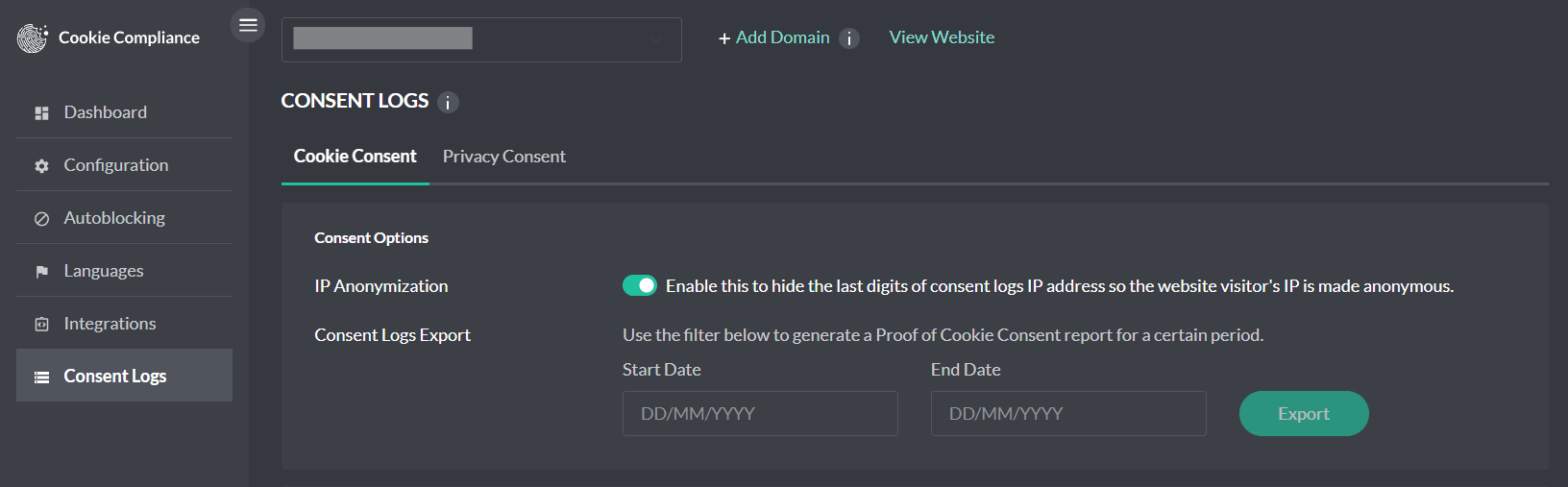
How to export (quick)
- Open Consent Logs in the application.
- Set IP Anonymization (and, on Privacy Consent, Email Anonymization) and pick the date range.
- Click Export.
Format & timezone
- CSV, UTF-8.
- Timestamps export in the application’s display timezone.
Retention & availability
- Export availability follows your plan’s retention window. Consequently, if older entries have rolled off, they will not appear in new exports.