Cookie Compliance adds a consent banner to your site, enforces choices at runtime, and records decisions for audit. You’ll create a property (domain) in the application, connect your site (WordPress plugin or manual snippet), publish, and verify that non-essential services stay paused until visitors choose..
Step 1 — Create your property (domain)
- Sign in to the Cookie Compliance application and click Add Domain.
- Open Configuration and set the essentials you want live on day one:
- Access Levels (Private, Balanced, Personalized)
- Purpose Categories (Basic Operations, Site Optimization, Content Personalization, Ad Personalization)
- Languages (English is provided; add domain languages and fill their strings)
- Default consent level and Duration (how long a choice stays valid before asking again)
- Geolocation defaults if you vary the starting posture by region
- Options such as Update consent visibility, Privacy Policy link, and GPC support (if your policy honors it)
- Click Publish Now in Configuration to activate the property.
Publishing first prevents a Not Connected (classic settings screen: Pending or Inactive) status when you connect the site.
Step 2 — Connect your site
WordPress (Cookie Compliance for WordPress plugin)
If you have performed the integration from WordPress, open Compliance in the WordPress admin, using the App ID and App Secret Key from the dashboard’s Integrations page. On a site that isn’t connected yet, open the Protection tab, enter them in the App ID and App Secret Key fields and click Connect Your Site. On a site that is already connected, use the App ID and App Secret Key fields in the Domain Info card and click Save and Connect (classic settings screen: Save Changes).
If the plugin still shows Not Connected (classic settings screen: Pending or Inactive), copy the App ID and App Secret Key from the application’s Integrations page again. On a site that isn’t connected yet, paste them into the App ID and App Secret Key fields on the Protection tab and click Connect Your Site. On a connected site, paste them into the App ID and App Secret Key fields in the Domain Info card and click Save and Connect (classic settings screen: Save Changes).
Manual implementation (any platform)
From Integrations, copy the generated snippet and paste it at the very top of <head>—inline init first, then the loader from our CDN. Keep both before any tag manager, analytics, or ad pixels.
It would look lie this:
<!-- Cookie Compliance: inline init -->
<script>
  var huOptions = {
    "appID": "YOUR_APP_ID",
    "currentLanguage": "en",
    "blocking": true,
    "globalCookie": false
  };
</script>

<!-- Cookie Compliance: loader. Copy the exact URL from your Integrations snippet; it may contain /v2/ -->
<script src="https://cdn.hu-manity.co/hu-banner.min.js"></script>
Step 3 — Verify the banner and enforcement
Load the site as an anonymous visitor (logged out or in a clean session).
You should see:
- The banner on first visit in the expected language.
- No non-essential scripts running before a choice (a held script file may still download, but it does not run). Two limits: tags that an allowed script adds later, such as tags fired by Google Tag Manager while Google Consent Mode lets it run, are not held, so gate those inside GTM; and on the Free plan blocking stops once the site passes its visit limit for the current cycle.
- After selecting Private, only Basic Operations run.
- After selecting Balanced or Personalized, only the purposes you mapped for that level run.
- The Update consent icon available if you enabled it.
In Consent Logs, confirm a new Cookie Consent entry with the selected Access Level and the purpose switches at that moment. Use Export to generate a Proof of Cookie Consent report when you need evidence.
Configure what visitors actually see
Access Levels & Purposes
Decide what Balanced should allow (for example, “measurement only” vs “measurement + on-site personalization”) and set the Purpose Categories to match. The banner shows clear labels; Autoblocking and integrations enforce the mapping.
Languages
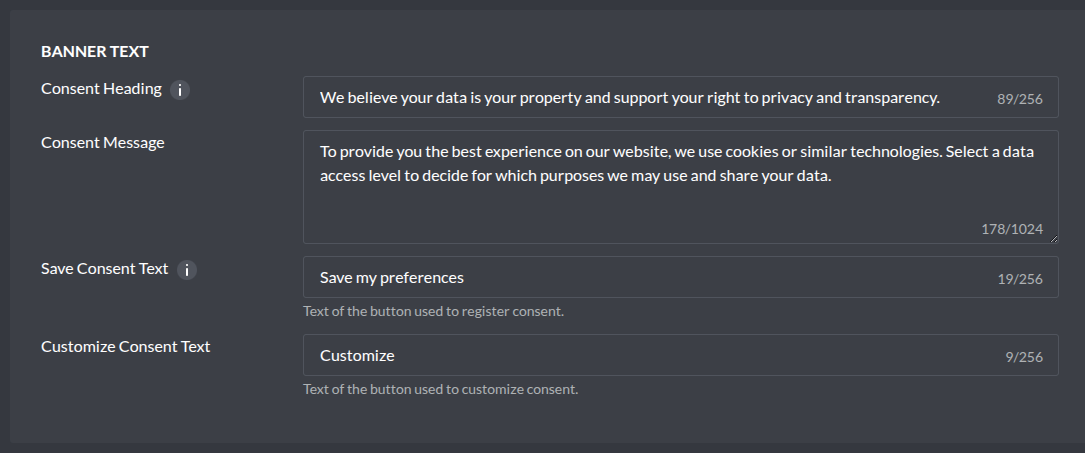
English ships complete. Add every language you serve in Languages, fill the text strings (banner title/description, buttons, Access Level labels, Purpose names/descriptions, policy links, duration labels), and click Save & Publish. The banner falls back to English for any missing text. WordPress sites select the language from the page’s locale and work with WPML, Polylang, and TranslatePress.
Geolocation
Use Managed or Manual Geolocation (Configuration → Laws) to set regional defaults such as Banner Display, Update consent, Autoblocking on/off per region, and policy links. These are starting rules; the visitor’s choice decides what actually runs.
Consent Modes
Enable the consent modes you use—Google, Meta (Facebook), Microsoft—so their tags read the same state the banner maintains. Tags stay constrained before consent and expand only after visitors accept the relevant purposes.
GPC support
If your policy honors Global Privacy Control, enable it. Sessions start protected: every non-essential purpose stays off (only Basic Operations run) until a visitor explicitly opts in. (In Show full banner mode, if Consent on Scroll, Click or Close is on, scrolling, clicking or closing the banner saves the preselected Default Consent Level as that choice.)
Common “Getting Started” issues (and fast fixes)
Status is Not Connected (classic settings screen: Pending or Inactive) → Publish in the application, then click Pull latest settings in the Domain Info card (connected sites only; the classic settings screen has the same button); if needed, paste the correct App ID and App Secret Key from Integrations.
Banner doesn’t appear → Ensure the inline init and loader sit first in <head>; disable aggressive JS optimization for our scripts; verify Banner Display = On for the visitor’s region.
Vendors fire before consent → Review Provider patterns in Autoblocking and confirm they map to the right Purpose Categories; keep our scripts ahead of GTM/analytics.
Language mismatch → Add that language and strings in the application; publish; in WP, click Pull latest settings in the Domain Info card (connected sites only; the classic settings screen has the same button); clear site/CDN caches.