These settings control the first-visit experience, how a choice gets made, and how visitors can change it later. They sit on several Configuration pages: the copy is on Content; behaviors (click/scroll/close), Update consent, privacy links and consent duration are on Behavior; geolocation defaults are on Laws; and the integrations that react to consent are on Consent Signals.
Consent messages (what visitors read)
On the Content page, define the banner’s headline, explainer, and primary buttons. You can also set the Unblock texts (message + button) for blocked embeds and the Preferences section labels, including names for Private, Balanced, and Personalized levels. Keep English here; add translations on the Languages page.
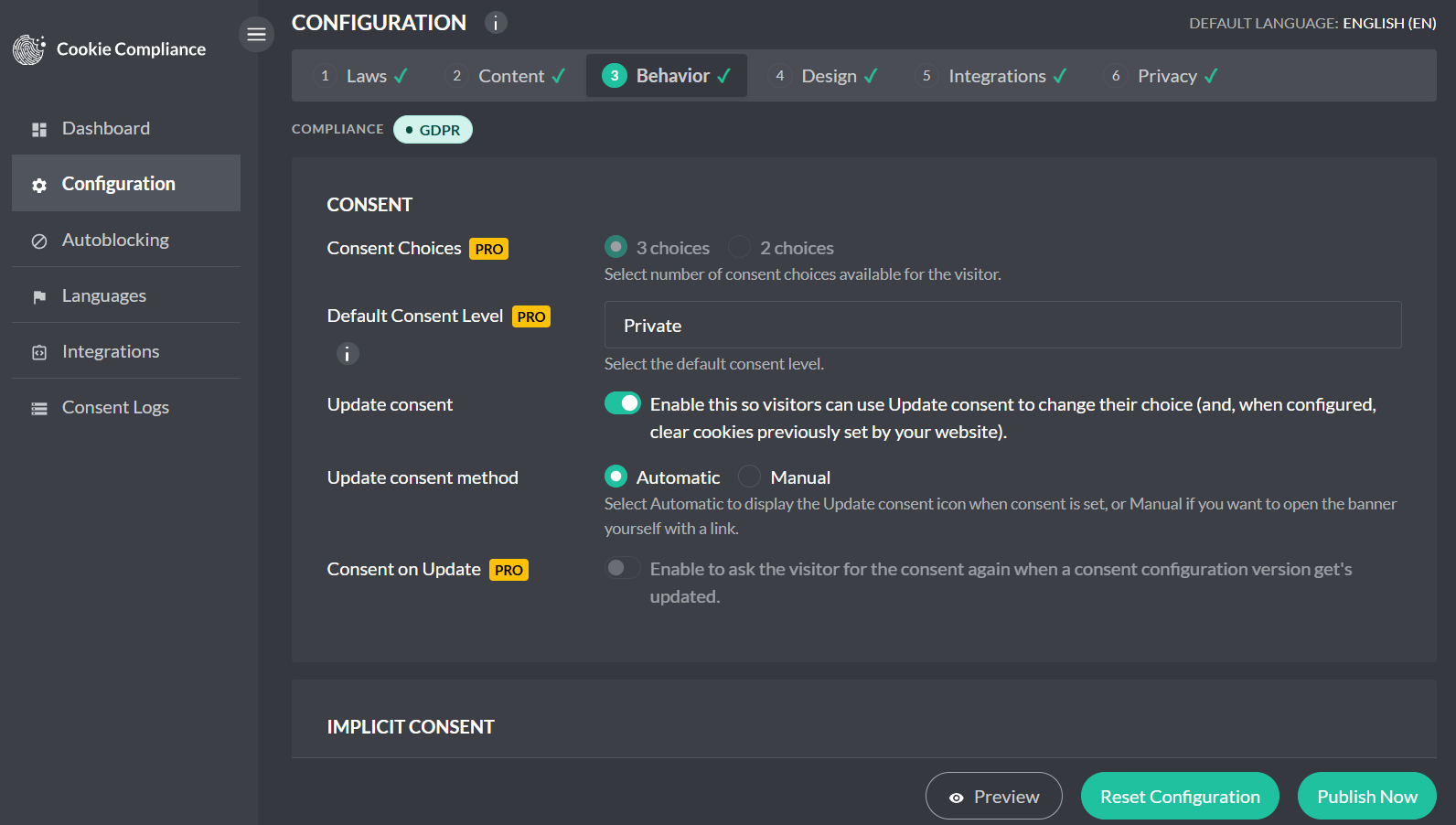
Default Consent Level (and why “Private” is safest)
By law, non-essential storage stays off until a visitor saves a choice. “Private” maps to a “reject non-essential” stance and works as the safest default (preselected on the Classic engine; the New engine preselects nothing). You can switch the default to “Balanced” or “Personalized” if your policy allows it.
How a choice gets recorded (behavior controls)
- Consent on Close — clicking the banner’s close icon registers the currently selected level. Classic engine only: not shown for sites on the New engine. Its saved value applies again if you switch back to Classic.
- Consent on Click — any click on the page registers the current level. Classic engine only: not shown for sites on the New engine. Its saved value applies again if you switch back to Classic.
- Consent on Scroll — scrolling beyond the Scroll Offset (0–500 px) registers the current level. Classic engine only: not shown for sites on the New engine. Its saved value applies again if you switch back to Classic.
- UI Blocking — lock the interface until the visitor picks a level (a strict, consent-first flow without forcing a particular option). Classic engine only: not shown for sites on the New engine. Its saved value applies again if you switch back to Classic.
- Keyboard focus on show — on Configuration → Behavior → Accessibility, turn on Move keyboard focus to the banner when it appears. Off by default, available on every plan, New engine only (unavailable on Classic). When it is on, the first time the banner appears on a page view, keyboard focus moves to the banner itself, so a keyboard or screen-reader visitor reaches it without tabbing through the page. It does nothing if something on the page already has focus. Focus lands on the banner box, not on a choice, so pressing Space or an arrow key records nothing, and the banner still does not lock the page.
- Reloading — reload the page after a choice or change when your stack needs it.
These align the banner with your regional and policy needs without extra code.
Update consent (two ways)
- Automatic — show the Update consent icon; visitors can reopen the banner anytime and change their choice.
- Manual — hide the icon and wire your own control with
data-hu-action="cookies-notice-revoke".
In both cases, the banner applies the new state and (if configured) removes cookies set under the prior state.
Privacy links
On the Behavior page, under Privacy links, turn on and label links to your Privacy Policy and, where relevant, Do Not Sell/Share. Turning a link off hides it in every language, on both engines. With Geolocation on, a region rule that sets its own Privacy Policy or Do Not Sell setting overrides the switch for visitors in that region (more below). On the New engine this also holds while script blocking is off (the plugin’s Script blocking engine setting is off, a WordPress admin is logged in, or a Free site is over its visit limit; on an over-limit Free site only for visitors whose country is already known): the matching region rule still decides, and the switch alone decides only where no rule applies or the rule does not set that link (Privacy Policy or Do Not Sell). Nothing is blocked in those cases, and the rule does not block or release any script.
Both groups of links, Privacy Policy and Do Not Sell/Share, contain similar options:
- Link Label – Text of the link used to access the “Privacy Policy” / “Do Not Sell” page
- Link URL – URL of the “Privacy Policy” / “Do Not Sell” page
- Link Target – Whether the link opens in the same or a new tab. Classic engine only: the New engine always opens these links in a new tab, so this setting is not shown for New-engine sites.
Geolocation (regional defaults)
On the Laws page, Geolocation sets regional defaults before any choice: whether the banner shows, whether Update consent is visible, whether Autoblocking starts strict, and which links appear. You can use the Managed baselines or set the rules for each region yourself (Manual). Consent Modes (Google/Meta/Microsoft) read the same state.
Global Privacy Control (GPC)
When GPC Support is on (Consent Signals page), Cookie Compliance honors the GPC browser signal as an opt-out boundary before interaction. By default (Show passive notice) the visitor sees no consent banner: Cookie Compliance records a Private choice for them and shows a brief notice. Choose Show full banner to show the banner instead; the visitor can then choose Private, Balanced, or Personalized, but every non-essential purpose stays off (only Basic Operations run) until the visitor explicitly opts in. (In Show full banner mode, if Consent on Scroll, Click or Close is on, scrolling, clicking or closing the banner saves the preselected Default Consent Level as that choice. This applies to the Classic engine; the New engine preselects nothing.)
Consent Modes (Google, Meta, Microsoft)
Turn on Consent Modes so platform tags adapt to the current consent state without custom code. On Configuration → Consent Signals, turn on Google Consent (and Facebook Consent or Microsoft Consent in their own sections), then click Publish Now. After a choice, the banner updates the modes so tags degrade/upgrade correctly.
Consent duration
On the Behavior page, under Consent expiry, pick the three durations for the banner’s Duration dropdown (e.g., 1, 3, 6 months; 1 or 2 years). The duration sets how long the consent cookie remains valid.